Audi Q7 Problems by Symptom: Sagging, Cold-Start Rattle and P2015 (4L/4M)

The Q7 is a big, heavy, beautifully built seven-seater, and most of the Q7s for sale in South Africa are diesels. That matters, because most of what goes wrong with a Q7 is tied to two things: whether the car has air suspension, and which engine sits under the bonnet. Know those two facts and you can predict most of the bills before they arrive.
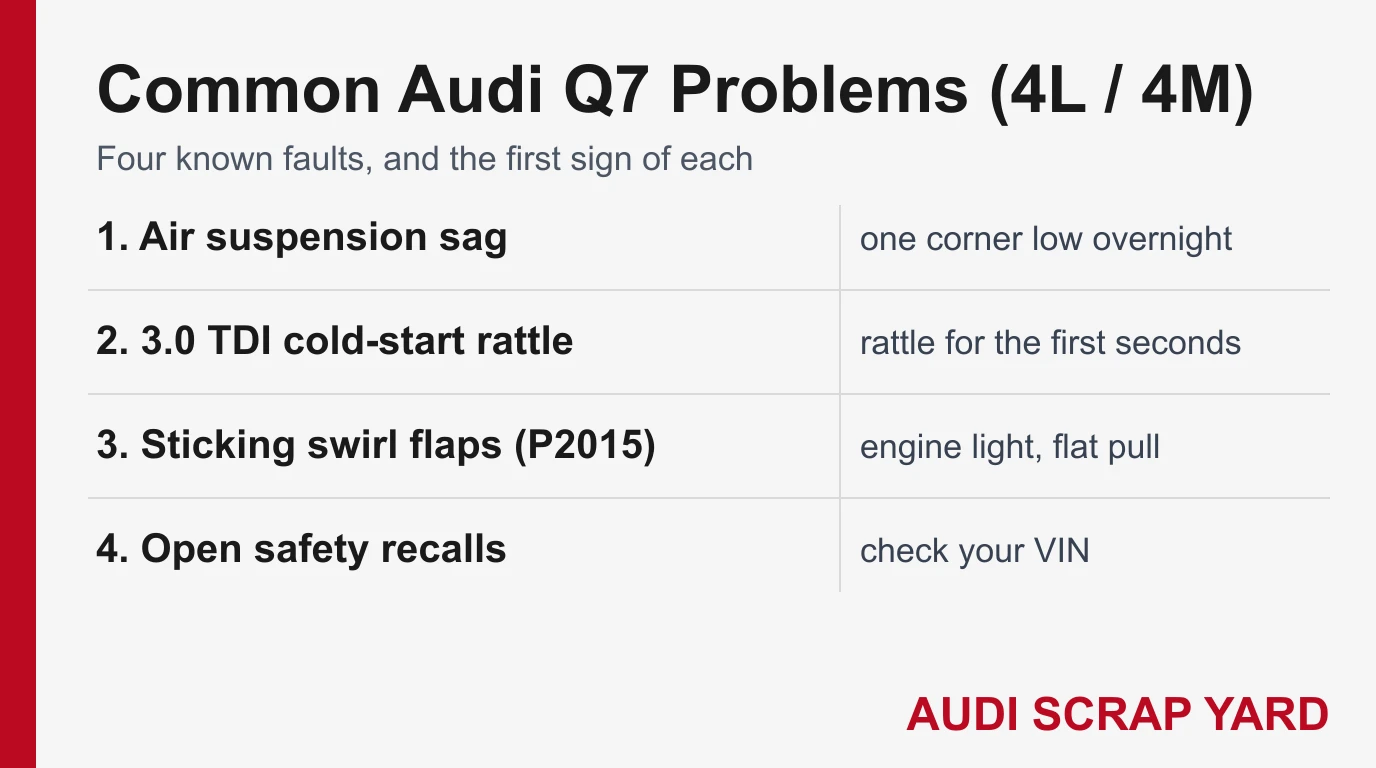
This guide is organised the way a problem actually reaches you: by symptom. Start from what the car is doing, work back to the likely cause, and you will know what to ask your workshop before anyone quotes. We have kept to Audi Q7 problems with a manufacturer, parts-maker or workshop source behind them, and for each one we say where a tested used part makes more sense than a new one.
Key takeaways at a glance
| What you notice | Likely cause | Mostly affects | The used part that fixes it |
|---|---|---|---|
| One corner low after standing, compressor running for long spells | Leaking air strut or seal, or a stuck pressure-holding valve | 4L and 4M with adaptive air suspension | Air strut, valve block or compressor |
| Metallic rattle for a few seconds after a cold start | Oil pump adaptation, or worn rear timing chains and tensioners | 3.0 TDI V6 | Chain kit, or a used engine if the chain has jumped |
| Engine light, fault code P2015, flat performance | Sticking intake swirl flaps or linkage | V6 TDI, and the early 4.2 FSI petrol | Intake manifold with flap motor and linkage |
| Nothing at all | An open safety campaign | Specific build dates and engines | A dealer check, not a part |
Most Q7s for sale in SA are 3.0 TDIs, so diagnose with that in mind
There are two Q7s on our roads: the first-generation 4L and the second-generation 4M that replaced it. Within both, the engine that matters most here is the 3.0 TDI V6. When we looked through the used Q7s listed on cars.co.za in October 2026, the first page of results was almost entirely 3.0 TDI quattro automatics, with only the odd V8 diesel or petrol mixed in.
So unless you know your car is one of the rarer petrol or V8 versions, read this guide as a 3.0 TDI owner. Your service history or a VIN check will confirm the engine, and the VIN is the first thing we ask for when quoting used Audi Q7 parts, so we can confirm fitment before anything ships.
Symptom: one corner sits low after the car has stood overnight
Air suspension is what makes a Q7 ride the way it does, and it is the system owners spend the most time worrying about. If your Q7 has it, the failures follow a familiar pattern.
The classic symptom is a car that sits low on one corner, or leans, after standing overnight. Sometimes the cause is a leaking air strut or a perished seal. Sometimes it is a valve that will not hold pressure: RepairPal records owner reports of uneven ride height caused by stuck residual pressure holding valves on 2007 to 2010 Q7s, and notes that an Audi service bulletin describes how to test them.
The expensive mistake is ignoring it. Every leak makes the compressor run longer to make up the lost air, and as one experienced owner put it on the Audi Owners Club Q7 forum, if you let that go on for extended periods it will burn out the compressor. That turns one leaking strut into a strut and a compressor. The same thread suggests a simple first check: spray soapy water around the air springs with the engine running and watch for bubbles.
Air struts, valve blocks and compressors are exactly the kind of part that costs serious money new and comes off a donor car in good condition. We supply tested used air suspension parts; tell us whether your Q7 is a 4L or a 4M and we will check what fits. Fix the leak first, then judge whether the compressor survived it.
Symptom: a metallic rattle for the first seconds after a cold start
A metallic rattle for a few seconds after a cold start on a 3.0 TDI makes most people think one thing: timing chain. Sometimes they are right, and when they are, it is a serious job. On this V6 the timing chains sit at the back of the engine, against the gearbox, not at the front.
An Australian workshop that wrote up exactly this complaint on a first-generation Q7 3.0 TDI explains what that means in practice: the engine and gearbox have to come out from underneath together and be split before anyone can reach the chains, which they put at roughly 21 hours of labour. That is why a chain job on a Q7 costs what it does.
The same workshop makes the more useful point. In their experience a timing chain is the culprit only about half the time. The oil pump on these engines is controlled by the engine management system, and resetting its learned values, clearing fault codes and applying any software update can cure the rattle without touching the chains. Get that checked by someone with the right diagnostic equipment before you agree to a gearbox-out job.
If the chains really are worn, do not keep driving on them. A worn chain that skips a tooth can do serious internal damage, and at that point a sound used engine is often the more sensible repair than a rebuild. We supply tested used Audi engines and can match one to your engine code.
Symptom: an engine light, code P2015 and an engine that feels flat
The V6 TDI has flaps in its intake manifolds that change how air swirls into the cylinders. They are moved by an actuator through small linkages, and over time they stop moving freely. Parts maker febi bilstein's technical note on the V6 TDI describes the chain of events: carbon builds up in the manifold, the flaps can no longer open or close fully, the strain wears or breaks the linkage, and the engine computer logs fault code P2015, an intake manifold flap position fault.
What you notice is an engine warning light and an engine that feels flat. It is not a disaster, but it will not clear itself. The fix febi describes is a replacement manifold with its flap motor and linkage, followed by a learning procedure on a diagnostic tool, which is why it belongs with a workshop that has one.
Petrol owners are not exempt. Audi issued a technical service bulletin for the same P2015 code on 2007 to 2009 Q7s with the 4.2 FSI V8, where a deformed oil seal behind the flap position sensor made the linkage stick. A used intake manifold off a low-kilometre donor is a cost-effective fix for either engine, as long as the part number matches.
No symptom at all: campaigns only a VIN check will show
The Q7 has been the subject of several safety recalls in the United States, listed on the NHTSA recall database. We could not confirm which of them were also run on South African cars, so treat this as a list of questions for an Audi dealer, who can check your VIN, rather than a list of faults your car definitely has:
- 2013-model 3.0 TDI built between June and November 2012 (campaign 14V516000): bits of plastic could foul a check valve and allow engine oil to reach the brake booster. If the booster's diaphragm then tears, the brakes lose their power assistance.
- Petrol Q7s from 2007 to 2017 (campaigns 16V660000, 18V818000 and 17V298000): the fuel pump flange could crack and leak fuel.
- 2017 to 2019 Q7s (campaign 20V149000): the bolt joining the steering shaft to the steering gear could loosen.
None of these is a reason to avoid a Q7. They are a reason to ask for the car's recall history when you buy one, and to have any open campaign attended to at an Audi dealer.
Turning the symptoms into a pre-purchase routine
Taking the faults above together, a used Q7 inspection should cover a few specific things:
- Leave it standing. If it has air suspension, look at the ride height after the car has stood for a few hours, and listen for how long the compressor runs when you start it.
- Start it cold. Ask for the car not to be run before you arrive, then listen to the first few seconds. A rattle that lingers is worth a diagnostic before you pay.
- Scan it. A quick diagnostic scan shows any stored fault codes, such as P2015.
- Ask about recalls. A dealer VIN check shows any open campaigns.
If there is a smaller Audi SUV in the family too, our guide to common Audi Q5 problems covers that model's own list of faults.
Listen to the car before you pay for parts
The Q7 is a durable, comfortable vehicle with a short list of known weak points, and most of them give you warning: a corner that drops overnight, a rattle on a cold morning, an engine light with a flap code behind it. Act on the warning and the bill stays reasonable.
When a part does need replacing, buying it tested and second-hand is how most owners keep a high-kilometre Q7 affordable. As an Audi dismantler in Centurion, we test every component before it goes on the shelf and courier it nationwide. Tell us your generation and engine and we will match the right used part to your exact car. Use the Get a Quote button on this page and we will come back to you with a quote.
Need a used Audi Q7 part?
Tell us whether your Q7 is a 4L or a 4M, plus the engine, and we will match a tested second-hand part to your exact car. Fast quote, nationwide delivery.
Frequently asked questions
What are the most common Audi Q7 problems?+
The ones that are well documented are air suspension faults (leaking struts, stuck pressure-holding valves and overworked compressors), a cold-start rattle on the 3.0 TDI that can come from the rear-mounted timing chains or from the electronically controlled oil pump, sticking intake swirl flaps that log fault code P2015, and a handful of safety recalls that are worth checking by VIN.
Why does my Audi Q7 sink on one side overnight?+
On a car with air suspension that usually means air is escaping from one corner, either through a leaking air strut or seal, or because a pressure-holding valve is not doing its job. Get it found and fixed quickly, because a constant leak makes the compressor run far longer than it should and can burn it out.
Is a cold-start rattle on a Q7 3.0 TDI always the timing chain?+
No. The chains sit at the back of the engine and replacing them means taking the engine and gearbox out, so it is worth ruling out the cheaper cause first. The oil pump on this engine is electronically controlled, and resetting its learned values, clearing codes and updating the software can cure the rattle. If it persists, have the chains and tensioners inspected before you keep driving.
What does fault code P2015 mean on an Audi Q7?+
P2015 is an intake manifold flap position fault. On the V6 TDI it is typically caused by carbon build-up stopping the swirl flaps from moving freely, which wears or breaks the linkage. The usual fix is a replacement manifold with its flap motor and linkage, followed by a learning procedure on a diagnostic tool.
Is it cheaper to repair a Q7 with used parts?+
For big items such as air struts, compressors, valve blocks, intake manifolds and engines, a tested used part is usually far cheaper than new. We test every part before it is sold and deliver nationwide. Send us your Q7 generation and engine for a quote.